We honestly thought that the next time you heard from us, we’d probably be on the road, or just about to start our Big Adventure, but because we keep getting asked the same question over and over again, we thought it might be worth exploring the question, our answer, and our reasoning. For as long as we have been contemplating and talking about this trip, almost every time it comes up in conversation, we get asked this question. In fact, just yesterday, at a lunch with some former workmates Sue was asked it, while at almost exactly the same time, Frank was asked it by our Dentist. Invariably, as we are talking about our route and some of the stops we’re making, someone pipes up and says, “So are you renting a Motorhome for the trip?” Our answer is always the same, “Nope…we’re going in our 2013 Hyundai Sonata Limited and staying in hotels.” Sometimes you see a little disappointment at our answer, because I guess this is the kind of trip many see doing in a Motorhome, but for us, it’s just not what we’re looking to do, and here’s why.
PRICE
Here’s the first downer for using a Motorhome, unless you already own one, the cost of rental. They are not cheap vehicles to rent! From research we’ve done, it looks like a smaller Motorhome, that would be perfect for 2 people rents for around $100 a day. Then, there is a fee of 35 cents per mile driven, plus it gets about 9 miles to a gallon of gas. On the other hand, our 2013 Sonata with 47,000 miles on it is fully paid for. Any service costs that we’d have to pay in preparation or during the course of our trip would be normal wear and tear items that we’d already have to pay for, and it will get close to 35 MPG on the highway all day. “But you’ll save the cost of hotels in the Motorhome”, you might say. Well, lets take a day out of our trip and compare the costs of the two styles of travel, and you decide.
For argument sake, lets take a day when we travel 300 miles and as a stop, let’s talk about our visit to Mount Rushmore in South Dakota.
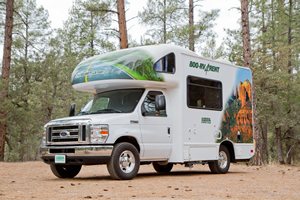 Motorhome
Daily Rental………………………………$100
Mileage Fee………………………………$105 (35 cents X 300 miles)
Cost of Gas……………………………….$ 75 (300 miles @ 9 MPG X $2.25 a gallon)
Campground………………………………$ 63 (KOA Hill City, SD)
Motorhome Total……………………………..$343
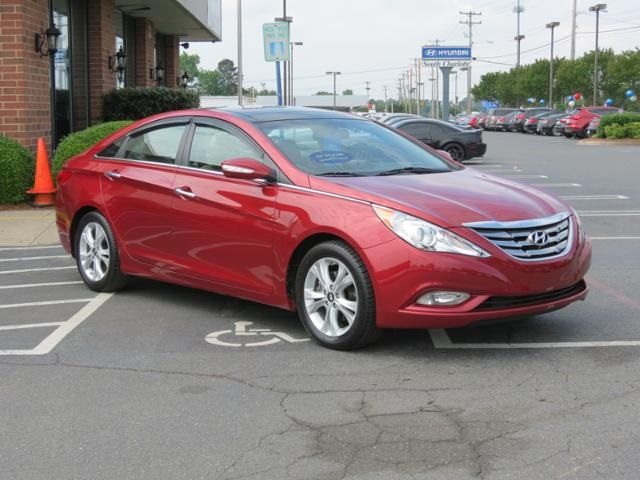 Sonata
Daily Rental……………………….$000
Mileage Fee……………………….$000
Cost of Gas………………………..$ 22.50 (300 miles @ 30 MPG X $2.25 a gallon)
Hotel……………………………………$ 86.51 (Econolodge, Keystone, SD)
Sonata Total…………………………….$109.01
Some might try and throw in the expense of food, but as we already travel with our cooler and supplies for breakfast and lunch, the only meal you might be able to argue about would be dinner, and we’d bet the difference there would not be enough to tip the balance towards renting a Motorhome. Add in the fact that our current plan is to be on the road at the very least 2 months, and to cover upwards of 6,000 miles, and you can see just how much the Motorhome would cost us in terms of daily rental, mileage charge, and gas! Score one for the car!
CONVENIENCE
Ever notice that when you see a Motorhome driving down the highway, if it’s an owned Motorhome and not a rental, it’s almost always towing a car or some motor bikes on a trailer? That’s because if they didn’t have this other form of transportation along for the ride, every time you’d go anywhere, you’d have to take your home with you! Think about it. You stop for the night at that KOA Camp Ground near Mt. Rushmore we used in the price example. We’re staying two nights in the area because there’s a lot to see, so let’s assume we’re doing the same renting a Motorhome. That first night you pull in, get the unit level, hook up the electric service, the water, the cable TV, and you settle in for the night. The next morning you’re off to Mt. Rushmore and what do you have to do? Yep, unhook the water, electric, cable TV, put away anything and everything you took out of it’s storage the night before, and like the turtle, head off to Mt. Rushmore with your house on your back. Then you get to Mt. Rushmore, and you’re not looking to park a car, but a Motorhome. Everything we’ve read, parking for a Motorhome at a lot of these sites is limited, and in many instances far away. We’ve also read that in places like Yellowstone National Park, it’s even a bigger pain to try touring in a Motorhome. But say you do have a successful day touring around the Mt. Rushmore area with your rented Motorhome. When you are done for the day, do you get to open the door of your hotel room and flop on the bed? Nope, you have to start the hookup procedure all over! And what about any cities that may be on your itinerary? How convenient do you think it’s going to be going around Denver or Salt Lake, or even Las Vegas in a Motorhome? All reasons that we think the car wins again.
LOCATION
You know the old Real Estate adage, Location, Location, Location. Well, when you are talking about campgrounds where you can spend the night in a rented Motorhome, it also comes into play. Campgrounds need lots of space, and because of that, are often farther afield from tourist destinations than hotels. In the Mt. Rushmore example we used earlier, the hotel we have reservations for is a mere 8 minutes from Mt. Rushmore, while that KOA we used as an example is 30 minutes away. The more populated the area, the bigger that time difference. You can stay in a hotel in Denver or Salt Lake, but a campground will probably be well outside the area that you wish to see, which will mean added travel time, and then the nightmare of trying to park the Motorhome! Some may disagree, but for us, another win for the car!
BEEN THERE, DONE THAT
Back when the kids were young, we owned a succession of pop-up campers. For about 6 or 7 years, we towed the pop-up behind our van. Many times, it was to return to a known campground where we went every summer, but there were also sightseeing trips that we went on. One year, it was up to Mystic, Connecticut, another year a 10 day journey through New York State and into Canada. On those sightseeing trips, most days we stayed one night in a location, so each afternoon it was set up the camper, and the next morning it was pack it up. Different campgrounds every day, setting up and knocking down daily, dealing with dirt and campground bathrooms, finding parking at tourist sights for our van/camper combo, driving down the road with a vehicle that was more affected by wind and the force of passing tractor trailers than a car….we’ve been there, and done that. It was great back when we did it, and it may be great for many people today too, but it’s just not what we want on this trip. Once again, for us, and based on past experience, the car wins out!
So, no, we’re not renting a Motorhome for our Big Adventure. We will be driving our Sonata, staying in a succession of national chain hotels, and National Park hotels, and enjoying clean sheets and good air-conditioning (or heat) every night! Nothing against Motorhomes and if your own one, we’re sure that they are a great way to travel, but it’s not just for us! The trip itself is going to be a Big Adventure enough for us, without adding the cost and inconvenience of a rented Motorhome. We’re just not prepared for that Big an Adventure!
Hope that answered your question.
 1 – The AAA. As long time members of the American Automobile Club, we have always used AAA Maps and Tour Books as our road trip bibles. If you are of a certain age, you will understand what we mean when we say there is just something about watching your progress on a paper map that seems to define a road trip. Luckily, some of the best paper maps you can get, are published by the AAA, and are a perk of your membership. In addition to the maps, the tour books have a wealth of knowledge about tourist destinations as well as hotel and restaurants listings in the area. If you are an AAA member, you can order maps, tour books and even triptiks (route directions) online. You can also just stop into a local AAA office (doesn’t have to be the state AAA you are affiliated with) and pick up maps, tour books, and even triptiks. Having a paper map in front of you so that you can check the location and relationships between places you want to visit is a must when planning a trip, and the tour books will give you valuable information about the places on your trip and be very helpful in deciding what you want to visit. If you are a member, stop in and pick up a couple of maps and tour books and start planning. If you are not a member, consider joining, as the price of your membership will be well worth it for the information you can get. (aaa.com….yearly membership $52)
 2 – Atlas – Because many people would not consider a road trip without a comprehensive road atlas, we purchased a Rand McNally Road Atlas. This one volume contains maps of all 50 states and lower Canada and assures us that we will always have a map showing our location, wherever we are in the US. The scale is smaller than the AAA maps which sometimes makes it hard to figure out exactly what you’re looking at, but sometimes makes it easier to see the relationship between two destinations. While we’ve used this volume a lot in our planning, for our actual trip we think it will take a back up roll to the bigger scale AAA maps.
 3 – Books – One of the things that you need to do when you are planning a road trip, is to decide what you want to see. If you have a “bucket list” of places that you want to include (like Frank wants to see Mt. Rushmore and Sue Yellowstone and the Grand Canyon), it will make your planning easier, as you already will have destinations in mind. If your “bucket list” is empty, or if you need more information about places, there are thousands of travel books you can purchase via Amazon or at a book store like Barnes and Noble that will help you flesh out an itinerary. Two that we have used are, “1,000 Places to See in the US and Canada Before You Die” (Workman Publishing, NY) and The New Roadside America (a Fireside Book published by Simon and Schuster, NY). The first covers everything from National Parks, historic sites, scenic byways, and the like, while the second will lead you to the odd things…like the biggest thermometer, ball of twine and those kind of offbeat attractions.

 6 – Google Maps – Looking at places on a map gives you an idea of where they are and the relationship of places to each other, but how do you know how long it will take you to get from say Chicago to the Black Hills? This was the position we were in when planning some sections of our trip, and we found an easy way to get a ball park estimate was to use Google Maps. Enter your starting point and your destination, ask for directions, and it will tell you not only the mileage but give you an idea of the driving time. Now, we know that it’s not fool proof, but we think it’s a good way to get an estimate so that you can make some decisions based on facts.
 6- GPS – While we like printed maps, we always travel with a Garmin GPS on our dash. It’s very handy when you are trying to find a hotel or site that you have an address for, and good to give you an idea exactly where you are. In addition, ours tells us what the local speed limit is, how fast we’re going, and also keeps us updated on traffic. We don’t depend on it totally, as we always try to have maps as a reference, and I’ve read on the internet that using a GPS in the American Southwest is iffy at best, as they are notoriously inaccurate there for some reason, but it’s a good tool to have in your tool box.
 R New Adventures